A bear in the driveway at 2:31 a.m.: how a virtual guard watches over a private home
Most people think of a security camera as something you check after the fact. This homeowner wanted more than that: someone actually watching. We designed and installed four cameras for one purpose, a live virtual guard, and placed every one of them so the guard could see the whole home. Early one September morning, that design paid off. The virtual guard spotted a bear on the property and immediately texted the homeowner to warn them.
Designed for a virtual guard from day one
Most camera systems are mounted on the building itself, under the eaves or at the corners of the house. That works for recording, but it has a blind spot built in: a camera fixed to a wall can't see around a corner. Someone standing just past the edge of the house is invisible to it.
Because this system was built specifically for virtual guard service, we did it differently. All four cameras are mounted on poles, set back from the home and aimed back at it. Positioned thoughtfully off the home's corners, a single camera can see two entire sides of the house at once. Placed this way, the cameras see the home the way a guard standing out on the property would, not just the wall they're attached to.
The night a bear came up the driveway
On September 20, 2026, at 2:31 a.m., camera IPC11, watching the front driveway, picked up movement. The camera's analytics drew a box around it and labeled it a person. It wasn't. The virtual guard looked at the footage and saw a bear crossing the driveway with a white trash bag in its mouth.
A recording on its own would have shown this the next morning. Instead, the virtual guard immediately sent a personal text message to the homeowner's phone, with snapshots from the camera, advising them of the potential threat on their property. The homeowner didn't have to open an app or scroll through hours of footage. Someone was watching, and someone told them.
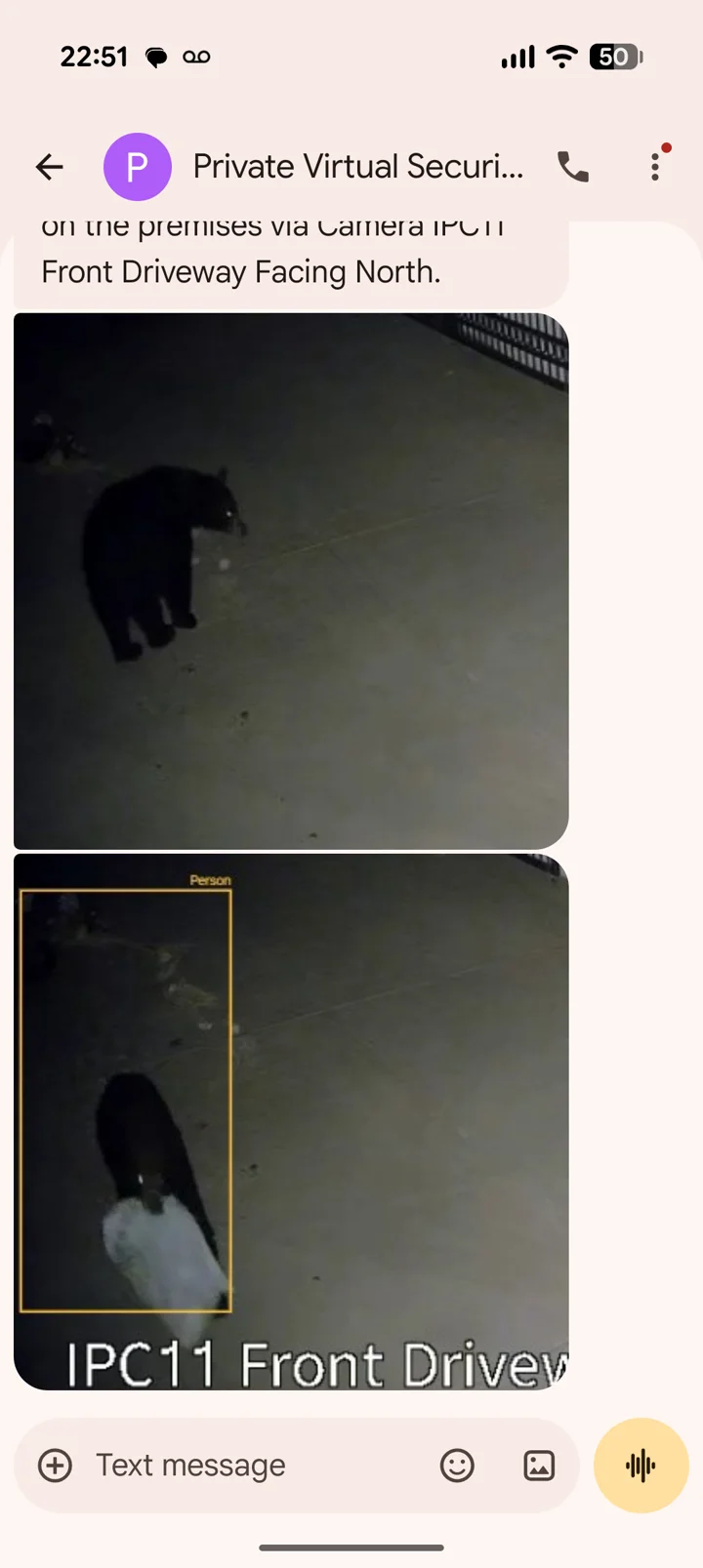
The text the homeowner received, with two snapshots from camera IPC11. The camera's AI tagged the bear as a "Person"; the virtual guard saw what it really was.
Not just for burglars and vandals
A virtual guard is usually thought of as protection against burglars and vandals, and it is. But at home, protection means more than the property. It means the people inside.
A bear in the driveway, someone lingering at the gate, a car that doesn't belong: anything that could be a threat to your home is something you want to know about while it's happening, not the next morning. That's what a virtual guard gives you. It's like having your own private security, always on the lookout for your home.
Why not a guard who drives by?
Many homeowners hire a patrol service that drives by the house during the night. It sounds reassuring, but look at what you're paying for. The patrol is at your home for a few minutes per visit. The rest of the night, nobody is watching, and anyone who learns the patrol's routine knows exactly when to show up. A drive-by patrol also costs more than a virtual guard.
Nobody watching between visits
Can't watch every side of the home at once
Costs more
No gaps between visits, because there are no visits
Sees every side of the home at once
Costs less
A guard who stays on-site is even harder to justify for a home. As we've laid out in comparing real costs of a virtual guard and a physical guard, a single unarmed guard covering just the overnight shift runs roughly $4,500–$7,000 a month in Southern California.
Want a virtual guard watching over your home?
AllTime Systems designs camera systems for virtual guard service from the ground up, with cameras placed where they can see your whole home, not just where there's a wall to mount them. Then our virtual guard watches over your property 24/7 and lets you know personally when something needs your attention, whether it's a burglar, a vandal or a bear.