Every HVAC unit in the building stopped. The cause was water inside one duct detector.
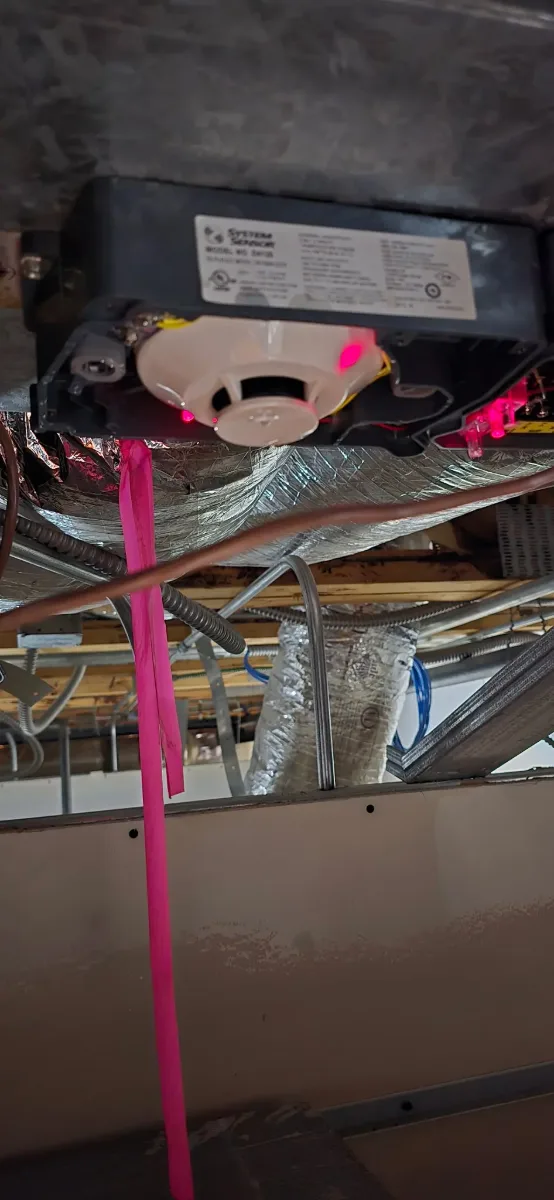
A multi-tenant commercial property lost heating and cooling across the entire building. The fire alarm panel had the answer, and opening the device confirmed it: a duct smoke detector mounted facing down had been collecting condensate until it flooded.
The call: no heating or cooling anywhere in the building
The property manager of a multi-tenant commercial building called us because the HVAC had stopped working — not in one suite, but throughout the building. Every tenant was affected at once. From a mechanical standpoint that is a confusing symptom, because multiple independent units failing simultaneously is not how equipment normally breaks.
The fire alarm system had already answered the question. The panel was reporting a duct smoke detector in one of the tenant units in a tripped state. That single device was holding the building's air handlers down, which is exactly what a duct detector is designed to do — interrupt the fan so smoke is not distributed through the building. The system was working correctly. What it was reacting to was the problem.
What came out when we opened it
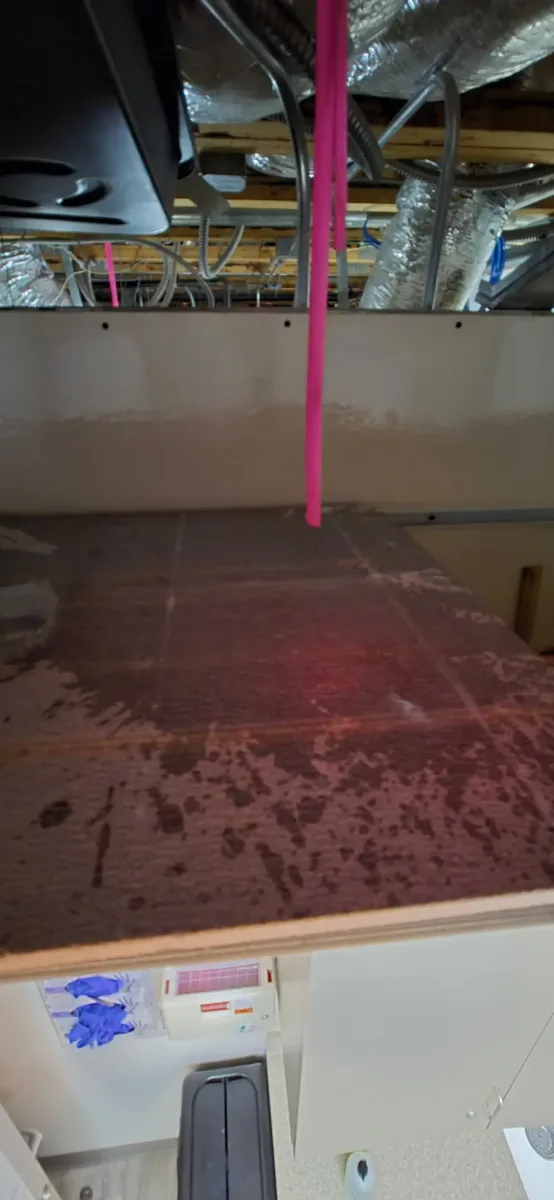
We traced the address to the unit, located the detector on the duct, and opened the housing. A large amount of water poured out — enough to leave a puddle on the floor below. The sensing chamber had been sitting in standing water, which is what put the device into a tripped state.
This volume did not arrive in one event. It built up over time inside a housing that had no way to drain.
Why the water was there: humidity plus the mounting orientation
Two things combined. The air being sampled carried high humidity, so condensate was forming inside the duct — normal enough on its own, and normally it drains away or evaporates without consequence.
The second factor is what turned that into a service call. The detector had been mounted facing downward, so its housing sat below the sampling point rather than beside or above it. Any moisture running down the duct or condensing on the tubes had somewhere to collect, and nowhere to go. The housing effectively became a cup. Over time it filled.
Nothing about the detector itself had failed. Mounted a different way on the same duct, in the same building, with the same humidity, it would have kept working.
The takeaway: where the detector goes is part of the install, not an afterthought
Duct detectors get treated as a box to be mounted wherever there is room and access. On a humid system that assumption has a cost. Orientation determines whether moisture drains away from the sensing chamber or toward it, and the difference does not show up on the day of the install. It shows up months later as a building with no air conditioning and a tenant asking why.
To be clear about what this was and wasn't: the detector on this job was a System Sensor D4120, and its installation instructions do not restrict mounting orientation. Nothing here was installed contrary to the manufacturer's documentation. California requires a duct detector to be listed for the air velocity, temperature and humidity present in the duct and installed per those instructions, and on that measure this install was compliant.
That is exactly why it is worth writing up. The code and the manufacturer both leave orientation to the installer, so a downward-facing housing is a judgment call rather than a violation — which means nobody catches it at inspection. On a dry system it may never matter. On a humid one it eventually does, and the failure arrives long after the paperwork is closed.
Worth reading alongside this: when California requires duct smoke detectors and when the fire alarm has to supervise them, which covers the code side in full.