Duct smoke detectors in California: when they're required, and when your fire alarm has to supervise them
If you own or manage a commercial building in Southern California, there's a good chance a duct smoke detector is sitting in an air handler above your ceiling right now. It's also one of the most misunderstood devices in the building. Mechanical contractors install it, electricians wire it, fire alarm contractors are expected to supervise it, and the fire inspector wants to see it shut the unit down. When nobody owns the whole picture, it becomes the reason a final inspection fails.
This post walks through the three questions we get asked most: when a duct detector is required, when it has to be tied into the fire alarm system, and what "HVAC shutdown" actually means under the code. We've included the code language itself so you can hand it to your mechanical contractor, your general contractor, or your inspector.
First, what a duct detector is (and isn't)
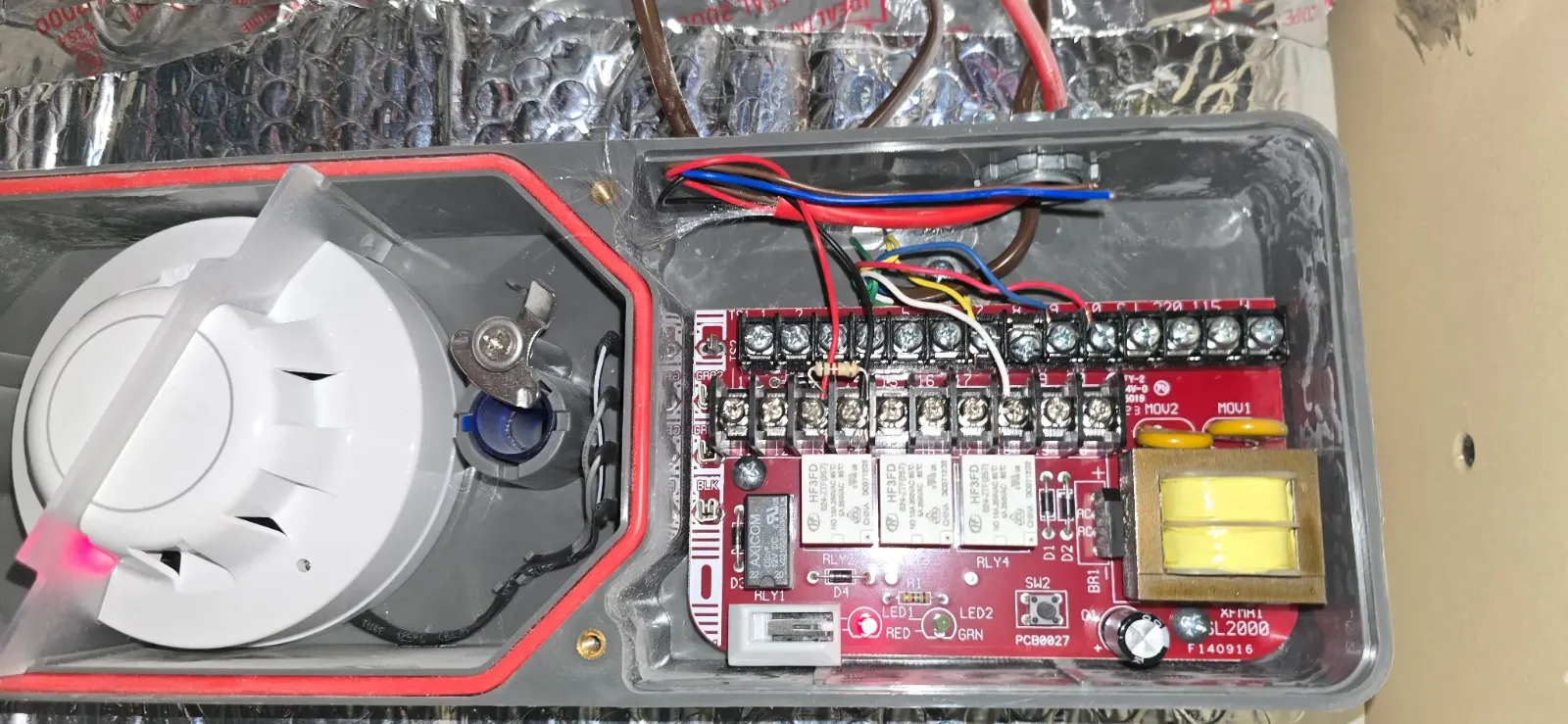
A duct smoke detector is a smoke detector listed to UL 268A and mounted on the outside of a duct, with sampling tubes that pull a continuous stream of air across the sensing chamber. Its job is narrow: detect smoke being moved by the HVAC system and stop the system from spreading that smoke through the building.
That is all it does. The code is explicit that a duct detector is not a substitute for the open-area smoke detection the building may otherwise require. It protects the air distribution system; it does not protect the room.
When a duct detector is required in California
California uses its own mechanical code, the California Mechanical Code (CMC, Title 24 Part 4), which is based on the Uniform Mechanical Code rather than the International Mechanical Code used in most other states. That matters because the trigger is different.
Under the CMC (the 2025 edition has been in effect since January 1, 2026, and this language carries over from the 2022 edition), the requirement is driven by the supply side. Any air-moving system that supplies more than 2,000 cfm to enclosed spaces within a building must be equipped with an automatic shutoff triggered by a smoke detector in the main supply-air duct, downstream of both the fan and the filters. The section number is 609.1, in Chapter 6 under Automatic Shutoffs — it is often miscited as 608.1, which was the numbering in an older edition.
Air-moving systems supplying air in excess of 2000 cubic feet per minute (ft3/min) (0.9439 m3/s) to enclosed spaces within buildings shall be equipped with an automatic shutoff. Automatic shutoff shall be accomplished by interrupting the power source of the air-moving equipment upon detection of smoke in the main supply-air duct downstream of both the fan and filters served by such equipment.
1. Where all portions of the building served by air-moving equipment returning air in excess of 2,000 cubic feet per minute (ft3/min) (0.9439 m3/s) are protected by a total coverage smoke-detection system in accordance with NFPA 72 and the California Fire Code, interconnection to such system shall be permitted to be used to accomplish the required return-air system shutoff.
2. Automatic shutoff is not required where occupied rooms served by the air-handling equipment have direct exit to the exterior, and the travel distance does not exceed 100 feet (30 480 mm).
3. Automatic shutoff is not required for Group R, Division 3 and Group U Occupancies.
4. Automatic shutoff is not required for approved smoke-control systems or where analysis demonstrates shutoff would create a greater hazard, such as shall be permitted to be encountered in air-moving equipment supplying specialized portions of Group H Occupancies. Such equipment shall be required to have smoke detection with remote indication and manual shutoff capability at an approved location.
5. Smoke detectors that are factory installed in listed air-moving equipment shall be permitted to be used in lieu of smoke detectors installed in the main supply-air duct served by such equipment.
The requirement that the fire alarm system supervise the detectors is not in 609.1 — it sits in the subsection immediately after it, along with the listing standard the detector itself has to meet.
Duct smoke detectors shall comply with UL 268A, shall be labeled by an approved agency, approved and listed by California State Fire Marshal, and shall be installed in accordance with the manufacturer's installation instructions. Such devices shall be compatible with the operating velocities, pressures, temperatures, and humidities of the system. Where fire-detection or alarm systems are provided for the building, the smoke detectors shall be supervised by such systems in an approved manner and installed in accordance with NFPA 72 and the California Building and Fire Codes.
Two details in 609.1.1 are worth flagging to a supplier. The detector has to be listed by the California State Fire Marshal specifically, not just labeled by a testing agency, and it has to comply with UL 268A rather than the UL 268 standard that covers open-area smoke detectors.
One more thing worth knowing at bid time: the 2,000 cfm threshold is per system serving an enclosed space. A lot of jurisdictions take the position that multiple units serving the same space with a combined capacity over 2,000 cfm still need shutdown, so don't assume four 800 cfm split systems in one open office are exempt.
Where the detector physically goes comes from NFPA 90A, which the mechanical code leans on. This is the language that decides whether a rough-in passes, and it is the part most often gotten wrong on the return side.
Smoke detectors listed for use in air distribution systems shall be located as follows:
1. Downstream of the air filters and ahead of any branch connections in air supply systems having a capacity greater than 944 L/sec (2000 ft3/min)
2. At each story prior to the connection to a common return and prior to any recirculation or fresh air inlet connection in air return systems having a capacity greater than 7080 L/sec (15,000 ft3/min) and serving more than one story
When the fire alarm system must supervise the duct detectors
This is where the mechanical code hands off to the building and fire codes, and where our work begins.
The California Building Code and California Fire Code carry identical language in Section 907.3.1. The rule is simple: if the building is required to have a fire alarm system under Section 907.2, the duct detectors must be connected to that system's fire alarm control unit.
Smoke detectors installed in ducts shall be listed for the air velocity, temperature and humidity present in the duct. Duct smoke detectors shall be connected to the building's fire alarm control unit when a fire alarm system is required by Section 907.2. The activation of a duct smoke detector shall activate a visible and audible supervisory signal at a constantly attended location and shall perform the intended fire safety function in accordance with this code and the California Mechanical Code. Duct smoke detectors shall not be used as a substitute for required open area detection.
1. The supervisory signal at a constantly attended location is not required where the duct smoke detector activates the building's alarm notification appliances.
2. In occupancies not required to be equipped with a fire alarm system, actuation of a smoke detector shall activate a visible and an audible signal in an approved location. Duct smoke detector trouble conditions shall activate a visible or audible signal in an approved location and shall be identified as air duct detector trouble.
Three things in that paragraph trip people up.
By default, a duct detector produces a supervisory signal, not a general alarm. Horns and strobes do not go off; the panel annunciates the condition, and the monitoring station reports it. The reason is practical: duct detectors see dust, construction debris, and kitchen smoke from the unit next door, and a building-wide evacuation for every nuisance event would train occupants to ignore the system. Exception 1 allows an AHJ or a design to make it a full alarm, but that is the exception, not the rule.
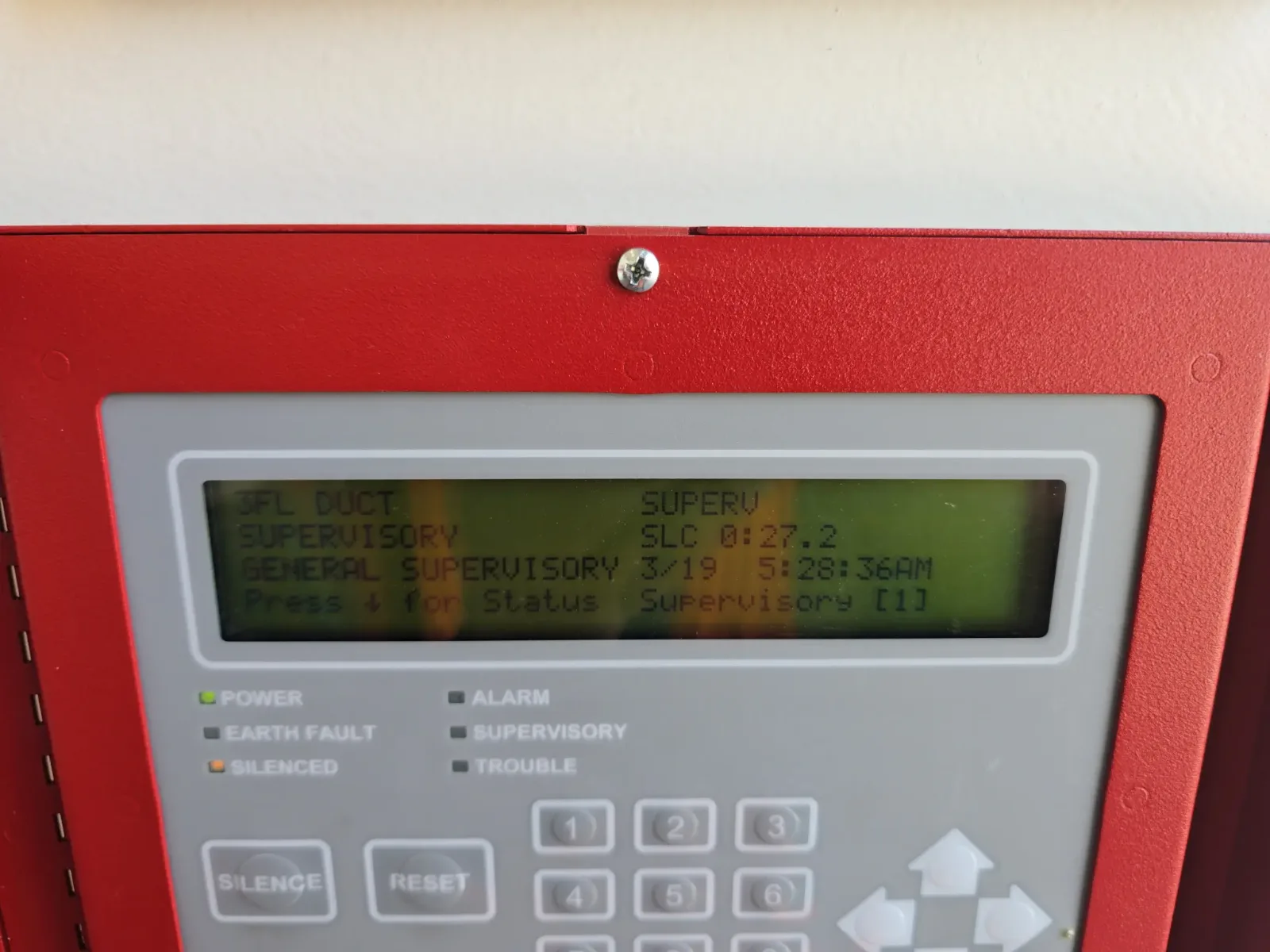
If nobody is on site around the clock, "constantly attended" almost always means a UL-listed central station. That is why duct detectors on an unmonitored panel are a common inspection finding.
Exception 2 covers buildings where a fire alarm is not required at all, such as a small B occupancy. The duct detector still has to be powered, still has to produce an audible and visible signal somewhere approved, and still has to annunciate trouble labeled as "air duct detector trouble." In practice that means a remote test/indicator station with a horn and LEDs, and it must be tested and maintained like any other life safety device.
NFPA 72, the National Fire Alarm and Signaling Code, reinforces all of this. Chapter 17 addresses detectors used for control of smoke spread and repeats that duct detection is not open-area detection. Chapter 21 (Emergency Control Function Interfaces) addresses the HVAC interface and states that duct smoke detectors connected to the fire alarm system shall initiate either an alarm signal at the protected premises or a supervisory signal at a constantly attended location or supervising station. Chapter 14 then requires the detectors to be visually inspected, functionally tested, and sensitivity tested on the same schedule as every other smoke detector on the system, and requires the shutdown function to be verified.
What "HVAC shutdown" has to do
The shutdown is the entire point of the device, and it is the part most often wired wrong.
The CMC says shutoff is accomplished by interrupting the power source of the air-moving equipment. That is a hard shutdown of the fan, not a "stop" request to a building automation system that may or may not honor it. The accepted methods are a listed control relay, either the auxiliary contacts on the duct detector itself or a fire alarm control relay module, that breaks the unit's control circuit or the fan contactor coil so the blower cannot run.
When the duct detector is on the fire alarm system, the fire alarm contractor typically owns the relay and the mechanical contractor owns the wiring on the unit side. Getting that scope boundary written into both contracts before rough-in avoids the finger-pointing at final.
Two more requirements matter at inspection. The shutdown must be tested end to end: introduce smoke or an approved aerosol at the sampling tube, confirm the panel shows the supervisory, and watch the fan stop. And reset should happen at the fire alarm control unit, not by cycling the thermostat. If the unit restarts on its own after the smoke clears, the installation is wrong.
The short version
If an HVAC unit moves more than 2,000 cfm into an occupied space in California, it needs a listed duct detector in the supply that kills the fan. If the building has a required fire alarm system, that detector has to be on the panel and monitored as a supervisory signal. If the building has no fire alarm, the detector still needs a local audible and visual annunciator and still has to be tested. Either way, the shutdown gets tested by actually stopping the fan.
We install, tie in, test, and certify duct detectors across Orange County and the greater Los Angeles area, and we're happy to walk a rooftop with your mechanical contractor before the inspector does. If you have a tenant improvement coming up or a unit that failed its last annual, reach out and we'll tell you exactly what the code requires for your building, with no surprises on the change order.