Replacing an aging POTS line with a cellular fire alarm communicator
Landline copper service is disappearing and getting more expensive by the year. Here's what it actually costs to keep paying for a POTS line versus switching to a cellular communicator — and where the numbers land over 5 years.
The problem with POTS lines today
Plain Old Telephone Service (POTS) has powered fire alarm dialers for decades, but major carriers are actively retiring copper infrastructure across California and nationwide. Since the FCC removed pricing protections on copper lines in 2019, commercial POTS lines that once ran $30–$50 a month now commonly cost $60–$200+ a month, with many businesses reporting bills well over $100 — and in some regions, far more. That cost only goes one direction as carriers keep pushing customers off copper ahead of full retirement in the coming years.
Reliability: a single copper line is a single point of failure
Cost isn't the only problem with POTS — reliability is arguably the bigger one. A POTS line depends on a single provider and a single physical copper path running from your building to the phone company's network. If that one path is cut, your fire alarm's monitoring connection is down, full stop.
That's not a hypothetical risk. Copper theft has become a serious, documented problem — driven by the price of scrap metal — and we've had customers reach out because vandals cut the physical copper line, most likely for the metal itself, leaving the building's fire alarm monitoring dead in the water. Because copper repair crews and materials are increasingly deprioritized as carriers retire the network, these repairs can take months, not days, to resolve — an unacceptable gap for a life-safety system.
The alternative: a multi-carrier cellular fire alarm communicator
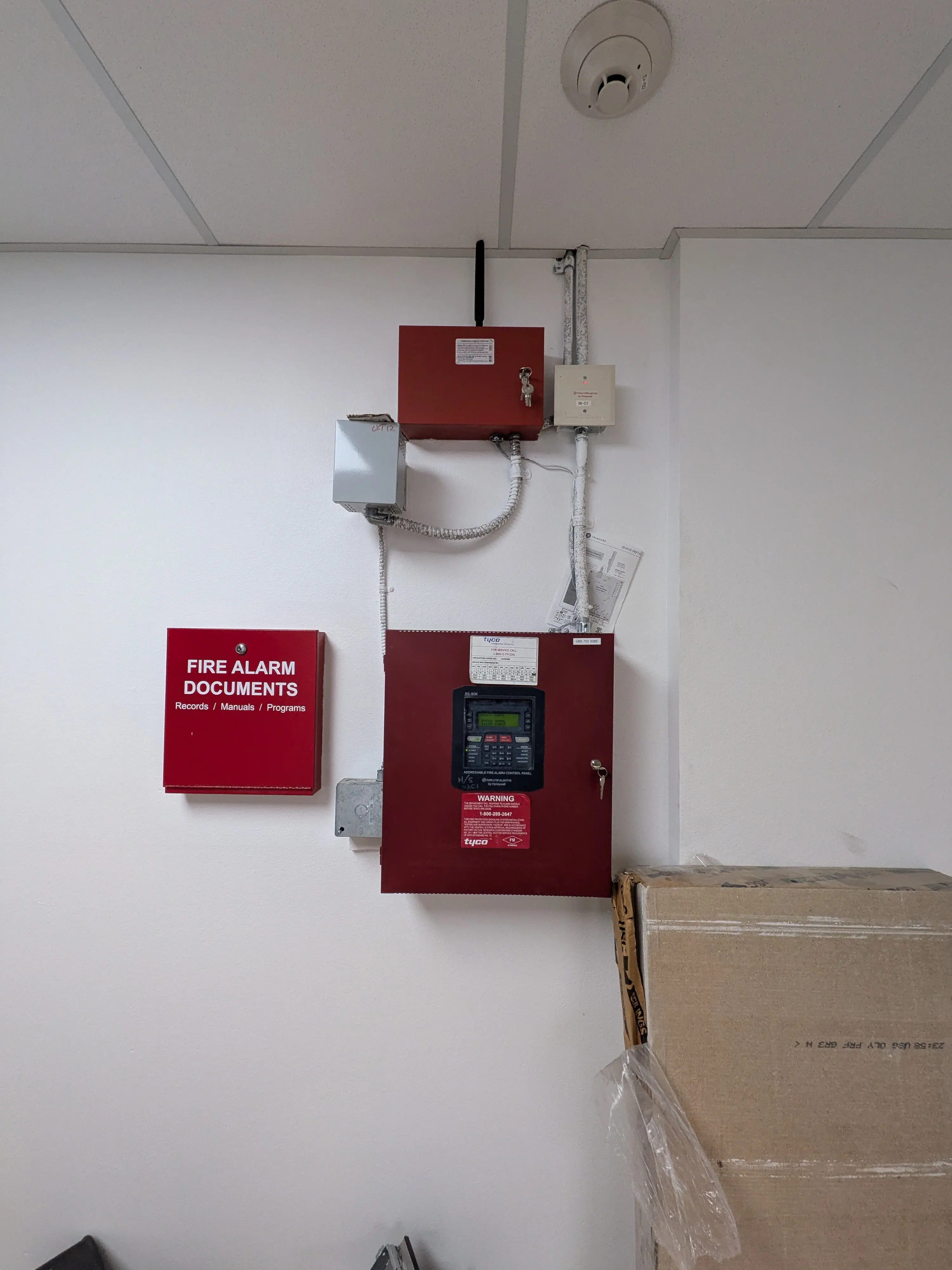
A cellular communicator connects directly to your existing fire alarm panel's dialer and transmits alarm, trouble, and supervisory signals over cellular networks instead of copper phone lines — no POTS line required. For this comparison we're using the Telguard TG-7FEM as our example: a UL 864 listed, NFPA 72 compliant dual-path communicator that connects over all three major U.S. cellular carriers (AT&T, Verizon, and T-Mobile) plus a facility's Ethernet LAN as a second path, with its own internal battery backup. Instead of depending on one carrier and one physical wire, it locks onto whichever network has the strongest signal and automatically fails over to another if that carrier goes down — no single point of failure left to cut, dig up, or steal.
AllTime Systems no longer installs single-carrier cellular communicators. We've standardized on multi-carrier units like the TG-7FEM specifically because a single-carrier device just replaces one point of failure (one phone line) with another (one cellular network). Multi-carrier, dual-path communicators are the more sustainable, reliable choice for a system that's only useful if it works every single time — so that's what we install.
Cost comparison: POTS monitoring vs. cellular monitoring
Using our own current monitoring rates as an example: fire alarm monitoring is $45/mo over a POTS line, or $80/mo over cellular, plus a one-time $400 installation cost for the TG-7FEM communicator. The POTS option also requires you to keep paying your phone carrier separately for the physical line itself — a cost that's now commonly $60–$200+/mo and climbing as carriers phase out copper.
5-year totals are estimates based on our current published monitoring rates ($45/mo POTS, $80/mo cellular) plus a $400 TG-7FEM installation, over 60 months. POTS line fees are paid to your phone carrier, not to us, and vary significantly by provider and region — figures above reflect current market ranges reported industry-wide, not a quote for your specific line. Switching to our 5-year price-locked cellular rate of $60/mo eliminates the separate phone line cost entirely and comes out lower than even standard cellular pricing over the same period — and unlike a POTS line, it can't be cut or stolen out of a pull box.