A camera that talks back: how live voice intervention resolves incidents before anyone has to show up
A commercial business center in the City of Industry, CA has been under live camera monitoring since 2025. Nearly every incident there follows the same pattern — someone shows up at the dumpster area, and a monitoring operator talks them off the property in real time, before a guard or officer ever has to be dispatched.
What "talkdown" actually is
A talkdown is live voice intervention: a monitoring operator, watching the camera feed in real time, speaks directly to whoever is on the property through an on-site speaker. It's not a pre-recorded loop playing on a timer, and it's not a passive alarm siren. A real person sees exactly what's happening on camera and responds to it in the moment, sometimes narrating specifically what they're seeing back to the person on-site: "You, by the blue dumpster, this is private property, you're being recorded, and you need to leave."
That specificity is what makes it work. Most people who wander onto a property they shouldn't be on aren't expecting to be watched, let alone spoken to directly and by name of location. Hearing a live voice call out exactly where you're standing removes any doubt that someone is actually watching, and that's usually enough on its own to end the encounter.
The pattern at this property
This business center's dumpster area (visible on Camera CH13) draws recurring attention, mostly individuals looking through or removing items from the dumpsters, along with occasional loitering elsewhere on the property. Monitoring has been live since August 2025. Below are real, documented incidents since then where our monitoring partner conducted a live talkdown as the first response.
In every incident above, the response started with a live voice warning, not a phone call or a dispatch request. A guard or law enforcement contact was only layered in when the situation called for it — most of these were resolved by the talkdown alone.
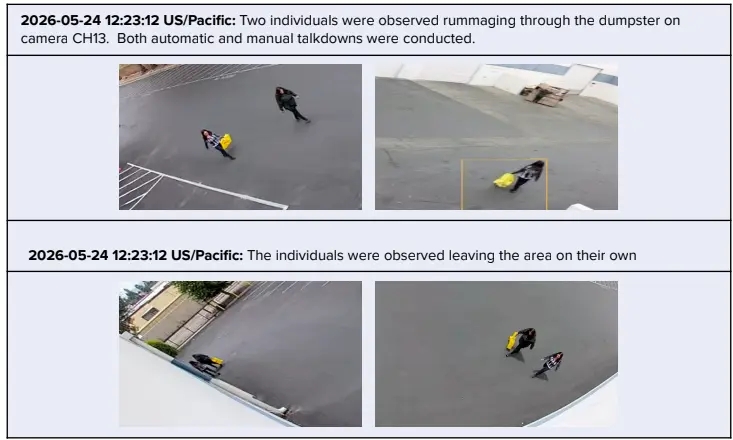
Actual camera footage from the May 24, 2026 incident: two individuals rummaging through the dumpster on Camera CH13. After automatic and manual talkdowns were conducted, both individuals left the area on their own — no guard or police dispatch required.
Why speed matters here
A dumpster-diving incident, a trespasser cutting through a lot, an unauthorized vehicle parked in a driveway — none of these are emergencies that justify a 911 call on their own, but they're also not something a property owner wants to just let happen night after night. That's the gap a phone-and-dispatch model can't close. By the time a property manager gets a phone call, reviews footage, and calls a guard company, the person is usually long gone, whether or not they took anything on the way out.
A talkdown collapses that entire timeline to seconds. The operator sees the activity the moment it happens and responds while the person is still standing there, which is the only window where a warning can actually change what happens next. Once someone's already left the property with something in hand, no amount of monitoring undoes that.
Not every situation ends with just a talkdown
Live monitoring isn't a substitute for law enforcement, and we don't sell it as one. Some incidents at this property escalated beyond a talkdown, including individuals sleeping on-site who needed a security dispatch, and one instance where the Sheriff's department was called in for multiple individuals on the property overnight. The value of a talkdown is that it gives the monitoring operator a fast, low-cost first option before reaching for those heavier tools, not that it replaces them entirely. In this property's case, the large majority of incidents never needed to go further than the talkdown itself.
What this costs versus what it prevents
Live monitoring with talkdown capability runs on top of a standard camera install, priced per camera per month. Compared to the alternative, an unmonitored system that only records footage for someone to review after the fact, the difference isn't just theoretical: recorded-only footage documents what happened after the person is already gone, while live monitoring with talkdown intervenes while it's still happening. For a property fielding a talkdown-worthy incident every few weeks, that's a small, predictable monthly cost against an open-ended stream of recurring trespassing, dumping, and loitering issues that would otherwise go completely unaddressed.